
Cloud County Court Docket Searches
Start with Kansas CaseSearch for any state trial case. Set Court to District to reach a Cloud County District Court file. The form lets you search by Case Number, Party Name, Business Name, Party As Business Name, or Citation Number. Type your term. Pick Cloud County when the county box appears. Add a date or case-type filter only if it helps. One caution: the form stays locked until its human check finishes. A locked screen means you are not done yet.
Treat whatever the web returns as reference case information, never a clerk-certified record. Read the court header first. Then work through party roles, the judge, and the event index. Continue with settings, disposition, and any document links. If the public Cloud County court docket will not open, or a filing you need is missing, go to the courthouse terminal. Call the District Court Clerk, or send a specific written court-record request.
- Identify District, Appellate, or the issuing municipal court from the paperwork.
- Search the full case number when it is available.
- Use the correct name, business, or citation format when no number is known.
- Read the Cloud County court docket from the header through its newest event.
- Confirm a live date or request a document through the responsible clerk.
Cloud CaseSearch Fields Explained
The CaseSearch form requires Court and Search Type before anything else. Search Term shifts with the method you pick. County appears only when needed. Under Additional Search Filters you get Case Type. Date of birth, File Date From, and File Date To sit there too. District case types run to Criminal, Civil, and Family. Probate or Mental Health rounds them out. Those controls can tighten a Cloud County court docket search. Just beware: a filter set too narrow may hide the very case you wanted.
| Control | Requirement | Cloud County use |
|---|---|---|
| Court | Required | Choose District for the county trial docket; Appellate is a separate search. |
| Search Type | Required | Case number, party, business, party as business, or citation. |
| Search Term | Required | Follow the live format tip for the selected method. |
| County | Conditional | Select Cloud County when the form displays it. |
| Case Type | Optional | Narrow to Criminal, Civil, Family, or Probate or Mental Health. |
| File dates | Optional | Limit by a known filing period, not a guessed hearing date. |
The official CaseSearch entry page is shown in the first assigned capture.
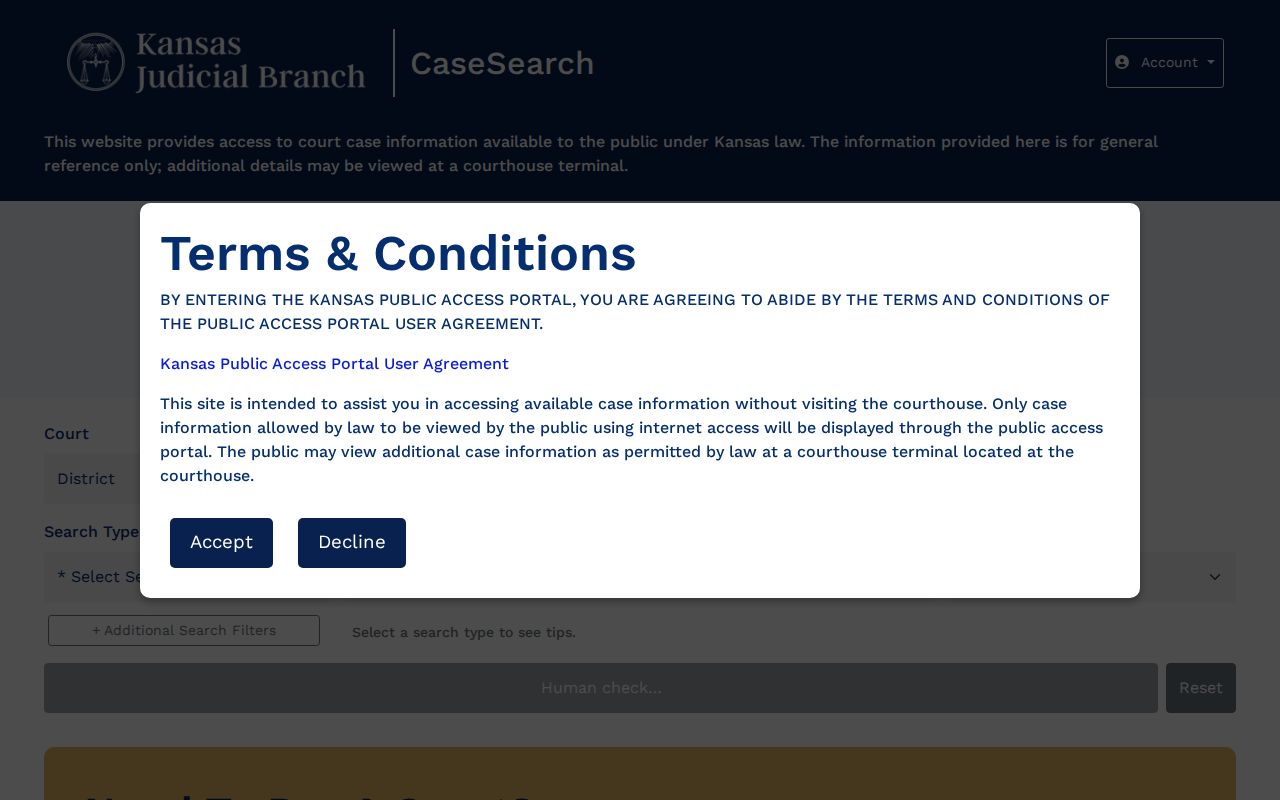
The live Kansas Judicial Branch application is the statewide public case-information route. Its court and county controls decide whether a result truly belongs to Cloud County.
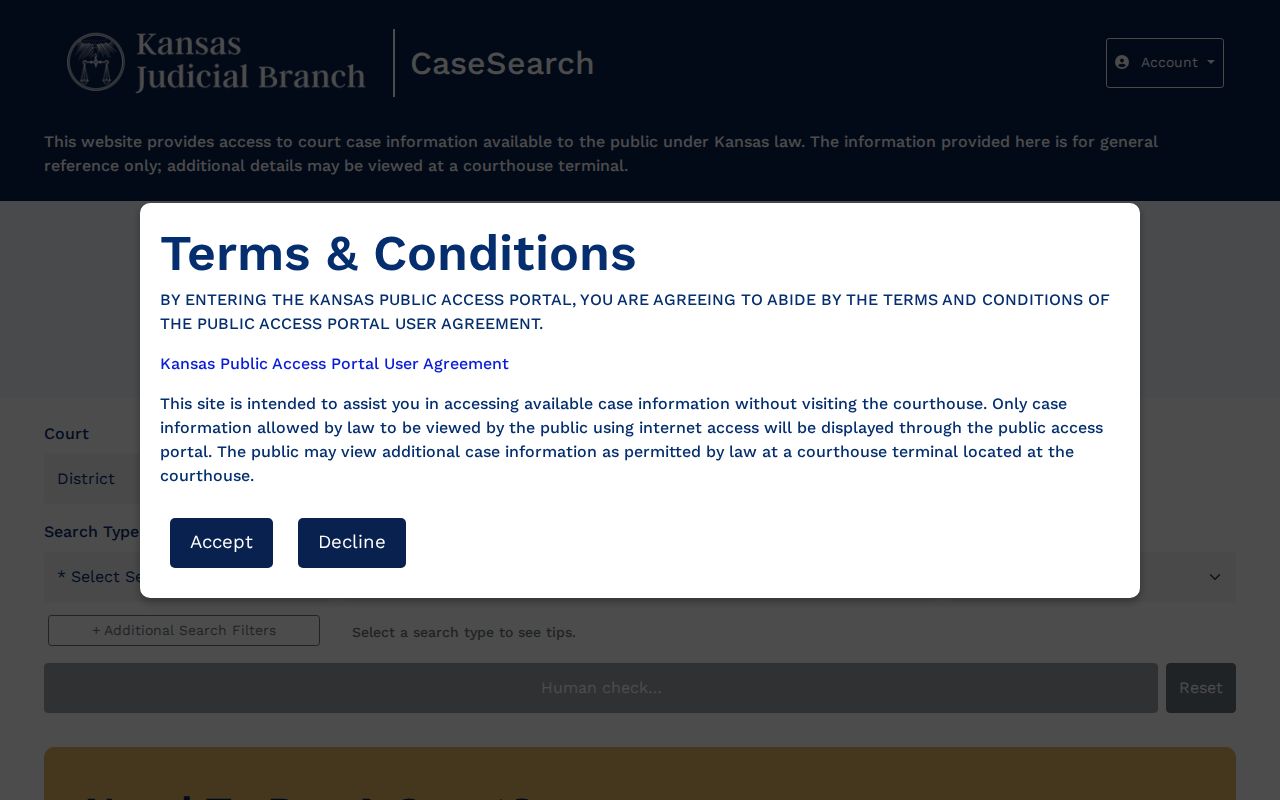
The interface starts blank. That matters. A search has to clear the human check before a no-result answer means anything.
Court Dockets: What They Show
Kansas labels the chronological view an events index. A Cloud County court docket usually blends a case header with party roles, filings, settings, rulings, and a disposition. One subtle point: the event date marks when the clerk entered or filed an item, and that day can differ from the event behind it. A setting is a scheduled court event. An order is a judge's direction or ruling. A judgment is the enforceable result of a claim. These terms are not synonyms.
| Case number | A unique identifier; a current example is 2024-CR-000123, though older formats vary. |
|---|---|
| Case type | Criminal, Civil, Family, Probate or Mental Health, or another court category. |
| Parties and roles | State, plaintiff, defendant, petitioner, respondent, and attorneys where public. |
| Events index | The dated line of pleadings, motions, notices, settings, orders, and outcomes. |
| Setting | Date, time, event label, judge or courtroom, and remote marker when exposed. |
| Disposition | Dismissal, plea, judgment, trial result, or other recorded closure. |
| Documents | Only the public filed images available for the case and its eCourt period. |
A blank field does not mean nothing happened. An event can show online with no document attached. A browser printout is never certified. Read the latest dated event first, then ask the clerk for the actual judgment or order whenever the precise legal result matters.
Cloud Docket Numbers and Names
Current CaseSearch tips want a full four-digit-year case number, such as 2024-CR-000123. Some formats carry a county prefix, and specialized numbers may add another. Keep the punctuation and the year exactly as your notice shows them. No county code in the number? Then select Cloud County on the form. Appellate numbers use a different number-only pattern. So Appellate mode will not fetch an ordinary district case.
- Party Name
- Use Last Name, First Name; the tip permits partial matching with an asterisk.
- Business Name
- Enter at least four characters and use the portal's wildcard rule.
- Citation Number
- Enter the full ticket number because no Cloud-specific partial format is published.
- Case Type
- The procedural category, not a description of the case outcome.
Cloud County publishes no official abbreviation sheet for short labels like CONT or DISP. Trust the portal's displayed text and its surrounding dates. Do not treat common shorthand as a local code.
Cloud County Courts and Their Dockets
Cloud County has one Kansas District Court. A magistrate division sits inside it, and separate municipal courts exist too. The District Court sits in the 12th Judicial District. Jewell, Lincoln, Mitchell, Republic, and Washington counties share that district. Its records cover felony, civil, family, probate, mental-health, juvenile, district traffic, and municipal-appeal cases. A city court keeps its own ordinance and municipal-traffic docket. Wherever the case began, that issuing court controls your first search.
| Court | Docket covers | First search or contact |
|---|---|---|
| Cloud County District Court | District criminal, civil, family, probate, mental health, juvenile, traffic, and appeals | CaseSearch, public terminal, District Court Clerk |
| District magistrate division | Matters assigned under Kansas law and district orders | Same unified District Court Clerk |
| Concordia Municipal Court | City ordinance and municipal traffic matters | Concordia Tyler citation route or city court |
| Other municipal courts | Each issuing city's ordinance and municipal traffic matters | That city's clerk or City Hall |
| Kansas appellate courts | Appeals with separate appellate case numbers | CaseSearch in Appellate mode |
A municipal appeal can leave a trail in Cloud County District Court, yet the original city record still stands. The same logic applies to CaseSearch: switching to Appellate mode does not widen a district search. Follow the case number and court header instead of assuming every local case lives in one database.
Cloud Filing and Search Systems
Kansas Courts eFlex and Kansas CaseSearch serve different users. Attorneys and registered filers use eFlex to file new cases and later documents. CaseSearch simply gives the public case information. A resident should not create a filing login just to read a Cloud County court docket. Filed documents can feed the case-management record later. But the filing worklist is not the events index.
The official Kansas Courts eFlex portal is that filing door.
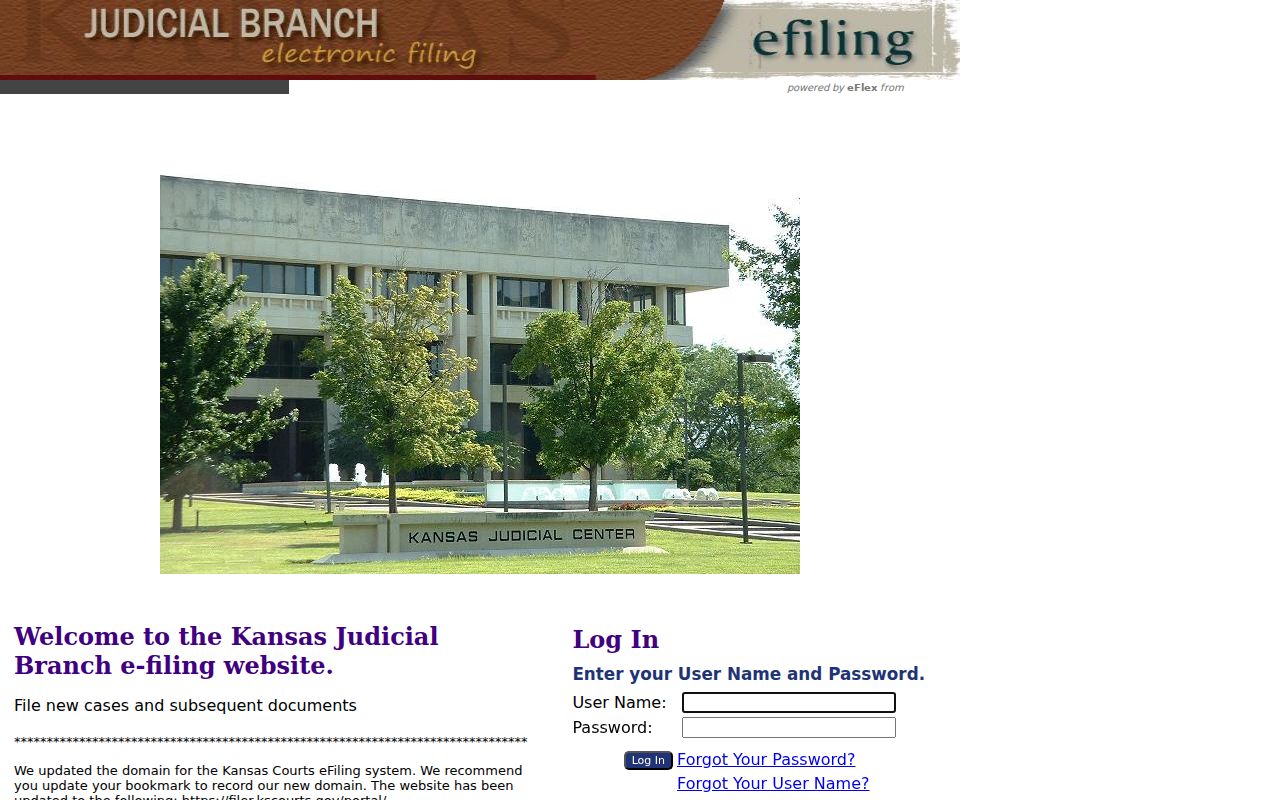
The login view makes the split plain. eFlex is for filing. CaseSearch and the courthouse are the public docket doors.
Say a CaseSearch result shows the header but no filing image. The file may predate the relevant eCourt document period, or Rule 22 may cover it. Turn to the terminal and the clerk, not an eFlex login. A request naming one pleading or order beats a broad demand. So skip the demand for everything tied to a name.
Court Dates and Settings in Cloud County
Cloud County posts no standalone daily calendar online. Your best bet is the hearing and setting detail inside the CaseSearch case record and events index. A terminal at the courthouse can show the same public slice. The District Court Clerk can confirm how a setting gets recorded. Kansas virtual-court guidance talks about posting public daily dockets. That is not proof Cloud County keeps a current public PDF.
When you read a setting, pull the case number, date, time, judge or courtroom, event type, and any remote-hearing flag. Then scan for later entries. A reset, continuance, cancellation, or amended order can change everything. The newest valid order beats an old screen or notice. Municipal citations work differently. Call the issuing city, since a city payment portal may not show the full hearing history. The Cloud County court schedule walks through the date-check process in more depth.
One caution: when a setting affects an appearance or deadline, call the responsible clerk. No public screen should override a newer court notice.
Cloud Courthouse Terminal Fallback
Rule 22 makes every Kansas district court keep a public terminal for case records and events indexes. In Cloud County, go to the Suite P District Court Clerk counter and ask for it. The terminal can reach public material the web portal lacks. That helps when an online record looks old or thin. It still cannot get past a seal, an expungement, a juvenile rule, or a protected document category.
Come prepared. Bring the case number and the issuing court. Bring the event or document date and a short description of what you need. The court does not publish the terminal room, its identification rule, sign-in policy, queue, or staff-help practice. It promises neither bulk exports nor staff research. Call 785-243-8124 before traveling. Do this if the file is old or the request is urgent. It also applies if you need accessibility help or want a certified copy.
A visit answers real questions. Is the file district or municipal, public or restricted, electronic or paper? Is a written document request required? It will not turn a payment result into a judgment or open a nonpublic record.
Docket Access Under Kansas Law
A set of court rules and Kansas Open Records Act provisions opens the Cloud County court docket to the public. Rule 22 governs public electronic district and appellate case records. Rule 24 protects personal information. K.S.A. 45-218 sets inspection and response timing, K.S.A. 45-219 permits copy fees and advance payment, and K.S.A. 45-221 lists records that need not be disclosed. That last statute also calls for separating open material out where feasible.
Core access authorities:
Supreme Court Rule 22 separates web portal and courthouse-terminal access and identifies restricted cases and documents.
Supreme Court Rule 24 places primary responsibility for redacting protected personal data on the filer.
K.S.A. 45-218 requires prompt action by the third business day or an explanation of delay.
K.S.A. 45-219 permits inspection, copies, lawful fees, and advance payment.
The third-business-day rule does not guarantee a finished complex file by that date. It requires action or a reasoned delay notice instead. If access is denied, ask for the governing rule and whether separable public portions can be supplied.
Missing Cloud Docket Documents
A Cloud County court docket can list a header and an event. It can hold back the document itself. Rule 22 bars some case types from portal access. The list includes adoption, many juvenile and protection matters, expunged cases, and grand-jury proceedings. It also covers other listed case types. Document groups face restrictions too. These include custody and support filings, dissolution records, trial exhibits, presentence reports, probable-cause affidavits, and unexecuted warrants.
When an item is missing, ask three questions. Is the whole case type excluded? Is the document itself restricted? Or is the record public but absent online because it is old or falls outside the eCourt document period? The first two may stay unavailable even at the terminal. The third points to the terminal, the clerk, or a written request. Redaction is not sealing, either. A public record may show a role, a year of birth, or a masked number while keeping other identifiers hidden.
Never read an empty online result as proof that no case exists. Check the court mode, the county, the search format, city custody, and the access rule before concluding anything.
How the Clerk Keeps Docket Records
The Cloud County District Court Clerk's Office keeps the unified state trial-court docket. District criminal, civil, family, probate, mental-health, juvenile, traffic, and appeal files all live there. Do not confuse it with the Cloud County Clerk. That office handles county-government records. Do not confuse it with each municipal clerk, either. Each municipal clerk keeps city ordinance and municipal traffic files. Which office holds the file matters as much as what you type into a search. The official Kansas Judicial Branch Cloud County District Court page lays out the state court record route and the courthouse contact.
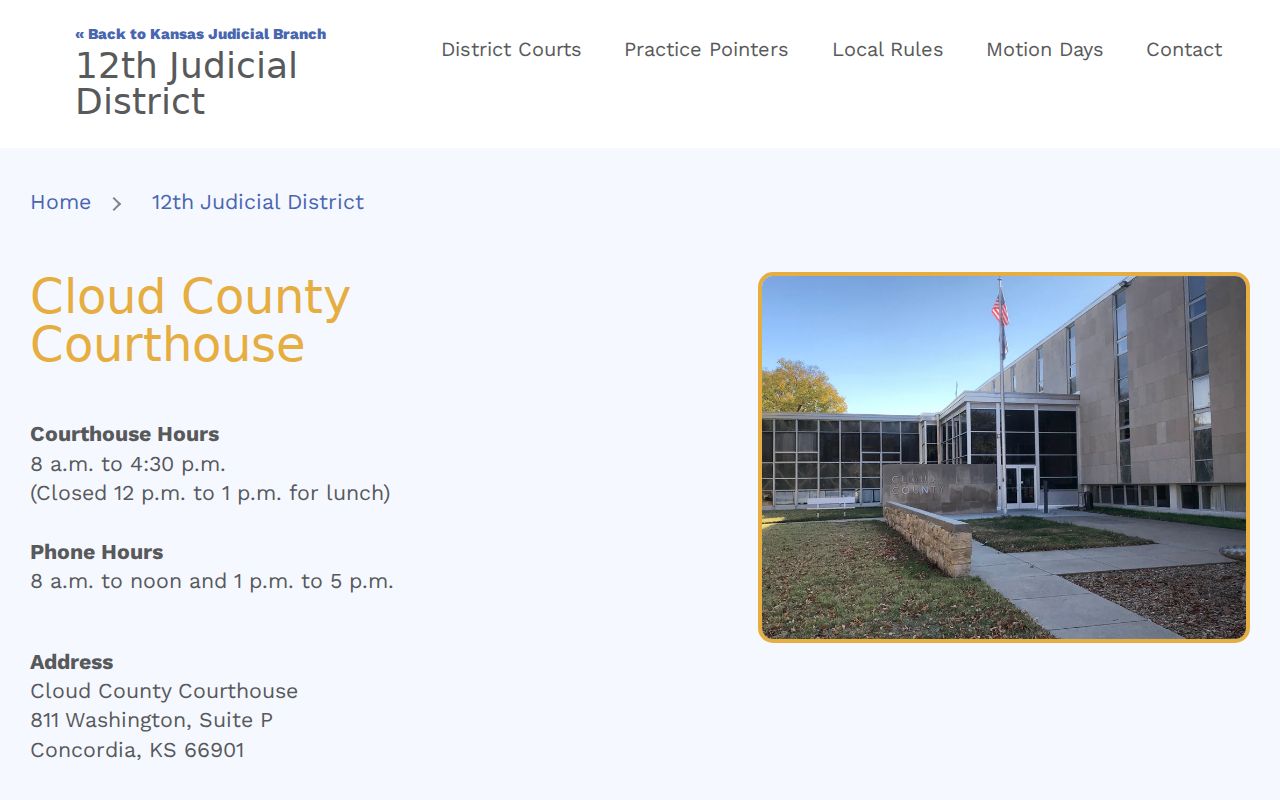
Suite P matters here. The state court record route runs through the published district-court contact in that suite, not through the county administrative clerk's office, so a Cloud County court docket request belongs with the District Court Clerk from the start.
Cloud County District Court Clerk's Office
811 Washington Street, Suite P
Concordia, KS 66901
785-243-8124
Fax: 785-243-8188
Several channels reach a Cloud County docket search. The documented ones are online search, terminal access, in-person inspection, phone, mail, and a formal KORA request. Fax appears in the published contact details. Treat it cautiously, though, because the clerk does not state that fax is an accepted request route. The office lists no public district-clerk email and no court-record drop box, so ask before you send payment or sensitive identity papers.
Three Cloud Clerk Roles
Many a Cloud County court docket request goes astray at the first step. The District Court Clerk holds the Kansas trial-court files. The Cloud County Clerk, by contrast, keeps county administrative records and handles those through the county's general open-records process. City clerks fall outside both, keeping municipal docket papers under their own city-court structure. Shared geography does not mean shared custody. Pick the clerk that matches your court records.
| Office | Record role | Useful request |
|---|---|---|
| District Court Clerk | Cloud County District Court dockets and filed court records | A named case event, order, plain copy, or certified copy |
| Cloud County Clerk | County-government administrative records | A county department record under the general form |
| Municipal clerk | City ordinance and municipal traffic dockets | A city citation, setting, judgment, or payment route |
A records request works best when it is specific. Give the clerk the court, the full case number, and the rough filing year. Add the document title, the date range you want, your preferred format, and a way to reach you. The court KORA form lets you choose email, mail, pickup, or fax delivery. The clerk can only send what the office supports. Cloud County sets no published copy or certification fee. Ask for an estimate before you commit. One more caution: a CaseSearch printout is handy, but it is not a certified document.
Cloud Docket Counts in Context
FY2025 filings put the Cloud County court docket in perspective. The district criminal table counts 167 filings: 90 felonies and 77 misdemeanors. Civil is bigger. That table reports 615 filings. Of those, 500 are limited actions, including 498 limited contract matters. Traffic adds another layer, listing 1,550 infractions and 436 misdemeanors among its filing classifications. Annual figures like these count filings in a set period. They say nothing about unique people, open cases, or outcomes.
Municipal numbers sit on a separate docket layer. Concordia's FY2025 row lists 584 total filings. Miltonvale reports 42 in the Other Crimes category. Clyde and Jamestown both show zeroes, and the table carries no Glasco row at all. A blank or missing row does not mean a city lacks a court or current records. For a live question about a city case, call that city's clerk.
City-by-City Court Dockets in Cloud County
Cloud County has five largest cities, per the official Census 2020 incorporated-place table. They are Concordia, Clyde, Glasco, Miltonvale, and Jamestown. Each city has its own route, separate from the District Court docket. Concordia stands apart. It runs a live citation and payment interface online. The other four profiles point to official City Hall, clerk, code, or state contacts. None of those cities offers a public municipal search form. Start a city citation with the city that issued it. A district filing or a municipal appeal goes through CaseSearch instead, and so does the District Court Clerk.
Concordia Court Records
Population 5,111 · Tyler citation lookup plus city court contact at 701 Washington Street.
Clyde Court Records
Population 694 · City Clerk route at 412 Washington Street; no public portal located.
Glasco Court Records
Population 441 · Main Street City Hall and clerk route; no public portal located.
Miltonvale Court Records
Population 440 · City Hall courtroom and clerk duties documented in the city code.
Jamestown Court Records
Population 237 · Official state contact lead for City Hall should be reconfirmed.
Population sets the profile list, not court jurisdiction or caseload. So read the citation issuer and the case number before anything else. If a city clerk points you to a later Cloud County District Court case, take that exact case number to the district search.
Map and Directions to the Cloud County Courthouse
Cloud County District Court files are kept at the Cloud County Courthouse in Concordia, where the District Court Clerk's Office sits at Suite P. The office holds the county's unified criminal, civil, family, probate, mental-health, juvenile, and district traffic case records. The courthouse also houses the separate County Clerk's administrative office, so ask specifically for the District Court Clerk rather than the county-government counter.
Cloud County District Court Clerk's Office
811 Washington Street, Suite P
Concordia, KS 66901
785-243-8124
Fax: 785-243-8188
Monday-Friday, 8:00 a.m.-4:30 p.m.
No official source describes courthouse parking, security screening, or the public terminal's exact room, so call 785-243-8124 before a visit that depends on same-day access or a certified copy. A Concordia municipal citation belongs at the separate city court at 701 Washington Street, not the county courthouse.